transformation-hosts-international
  • Community
    • Community of Practice
    • Vision
    • Manifesto
    • Meetings
    • Partner
    • Hosts
    • Community Blog
  • Projects
    STSEM
    STSEM
    Barefoot Coaching
    Barefoot Coaching
    International Families
    International Families
    Transformative Learning +
    Transformative Learning +
    Hosting Empowerment
    Hosting Empowerment
  • Toolbox
  • News
    The melody of our future
    The melody of our future
    Online Future Forge
    Online Future Forge
    COP moving forward
    COP moving forward
    10th Anniversary of the Hosting Transformation Community
    10th Anniversary of the Hosting Transformation Community
    Alchemy of Transformation #1 – Cohesion
    Alchemy of Transformation #1 – Cohesion
    A brilliant start to the anniversary year
    A brilliant start to the anniversary year
    Looking back at 2020
    Looking back at 2020
    Futuromat
    Futuromat
    Book launch 31.8.
    Book launch 31.8.
    Webinar Transformative Learning
    Webinar Transformative Learning
    Future music canvas for free download
    Future music canvas for free download
    The melody of our future
    The melody of our future
    Online Future Forge
    Online Future Forge
    A good start to the lush 20s2.0!
    A good start to the lush 20s2.0!
    Competency framework for transformative learning
    Competency framework for transformative learning
    Transformative Learning – an online dialogue
    Transformative Learning – an online dialogue
    Looking back on the Hosting Innovation Certificate Training
    Looking back on the Hosting Innovation Certificate Training
    Looking back at the Pilotyear of the Visionautikum
    Looking back at the Pilotyear of the Visionautikum
    Facilitating Transformation
    Facilitating Transformation
    Call for free 3-day transformative learning event 28.5-1.6.
    Call for free 3-day transformative learning event 28.5-1.6.
  • Resources
    Hosting Transformation Storybook
    Hosting Transformation Storybook
    Ocean of Abundance Meditation
    Ocean of Abundance Meditation
    Risk Assessment
    Risk Assessment
    A transformative Edge
    A transformative Edge
    Live your dream – Workbooklet
    Live your dream – Workbooklet
    Online Transformative Learning Enquiry
    Online Transformative Learning Enquiry
    Overview BLAST
    Overview BLAST
    Online Transformative Learning – a practical guide
    Online Transformative Learning – a practical guide
    Perspective Carousel Video
    Perspective Carousel Video
    Project Tree Template
    Project Tree Template
LOGIN
Supportive Inner Beliefs

Supportive Inner Beliefs

Turning one's own thoughts into allies
What we think about a situation, about ourselves and about how the world works, significantly influences our feelings and our choices. By consciously shaping our thoughts with supportive beliefs, we open up new possibilities and can navigate challenges with more ease.

What is
What are inner beliefs?
about ?

What is
Supportive Inner Beliefs
about ?
What is this Method about ?

With inner beliefs we refer to deeply held convictions that influence one’s perception, thinking, decisions and behaviour. They are personal assumptions or thought patterns about oneself, about how the world works, how people are, or how to assess a particular situation. 

Inner Beliefs are an accumulated mix coming from experience, upbringing, interpretations and cultural influences throughout our lives. Not all of them are helpful and often we are not aware of them.

What are examples of supportive and hindering inner beliefs?

Here are a few examples of limiting, hindering beliefs: 

  • I'm not good enough.
  • It's hard to make money in my profession. 
  • Other people are unreliable.

Here are a few examples of supportive beliefs

  • I am a darling of fortune
  • If I set my mind to something seriously, I can do it.
  • I am valuable.

You can think of inner beliefs like an imaginary map based on thoughts and feelings that helps you navigate through life. It shows where dangers supposedly lurk and where it is likely to be worthwhile to wander. It includes personal preferences and indicates how flat and easy or steep and stony a path is to get to the points of interest such as dreams and goals. 

How can we work with Supportive Inner Beliefs?

Working with Supportive inner beliefs is a practice to review and redesign this inner map in order to pave ways to the promising destinations and to keep from going to places that are not beneficial. It is about looking at single sentences in order to  understand one’s thought patterns and aligning them with goals and dreams.

When and why is this Method used ?

Supportive Inner Beliefs help remove blocks and overcome limitations that prevent us from achieving our goals and dreams. When you're helping your participants to break new ground, tackle challenging projects, or do something they've never dared before, working with supportive inner beliefs is extremely helpful. You can also use them when your participants are stuck on an issue or trapped in sabotaging behaviour patterns.

Where does this Method come from ?

Working with Supportive Inner Beliefs has come up in many areas of psychology, self-development and psychotherapy without a clear source it can be traced back to.
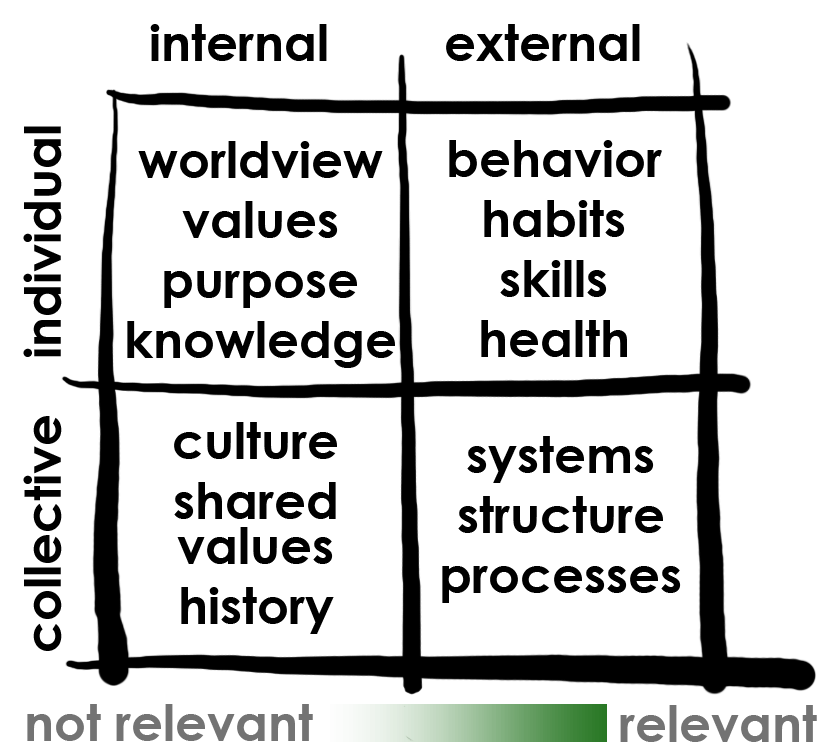

Ken Wilber

Audience

Audience

Is participant experience relevant for Supportive Inner Beliefs ?

It's okay if participants haven't seen the inside of a classroom in years

Physical Trust Needed

[content_physical_trust]

Mental Trust Needed

[content_mental_trust]

Audience description for Supportive Inner Beliefs

Supportive Inner Beliefs are helpful for anyone with the ability and willingness for self reflection. It is especially recommended for participants

-who want to explore new possibilities in themselves and go beyond the limits of what they thought possible or dared before.

-who want to tackle big challenges such as starting a new project or business.

-who feel stuck in their thoughts or lives or trapped in recurring behaviour patterns and want to act with more ease.

Other prerequisites for participants

The participants should have a topic they want to work with - a dream or goal they want to reach, a challenge they want to master or a difficulty they want to overcome. Alternatively you can give them some time at the beginning to think about a topic to work with during the session.

Requirements

Requirements
Experience level of the facilitator
Routine as participant OR professional facilitator
Number of Facilitators :  
1
Location requirements

Not specifically

Run Through

Run Through
Pre Exercise
Steps

Introduce Inner Beliefs

Give your participants a brief description of inner beliefs. You can get inspiration from the section “How is it used” above. Give some examples, preferable of the area of your participants. Tell them a personal example of a change in your own life that happened because you changed an inner belief. This is not only valuable to illustrate how powerful the change of inner beliefs are, but also gives your participants a good role model of daring to talk about your own inner beliefs and misconceptions that burdened your life in the past.

Instructions for Supportive Inner Beliefs

Announce that you will form groups of three to help each other find Supportive Inner Beliefs (pairs are possible, too, but three persons are ideal in our experience). Tell them that you will give them the instructions and a few tips BEFORE they gather in groups. You could introduce it for example like so: “After my explanation I will invite you to form groups of three to support each other to find Supportive Inner Beliefs for your situation/challenge/dream. I recommend that you focus on finding an inner belief sentence for one casegiver of your trio first and then swap roles. First the casegiver explains briefly the situation (if that has not already happened). For the casegiver, it is important to know that you only tell about your situation what you feel comfortable with. If the topic is too private to share it with the two others, choose another lighter, easier topic or just tell the parts you are willing to share. Then, all together, make suggestions on possible new inner beliefs, formulated in one sentence each. Understand that those are all only suggestions. The casegiver has the last word and decides if that sentence feels right to them. Once you have found a sentence (or two or three) for the first person, shake it off, move a little around and bring your focus to the next casegiver. Those tips help find powerful Supportive Belief Sentences: -Make a simple sentence. Avoid abstract terms and long or complicated subordinate clauses. The ideal sentencecan be understood by a 4 year old child—this is the best way your subconscious mind can grasp the idea. -Make sure it is a sentence that either includes you or is very close to you. There is no big change happening when you change your thinking about an abstract matter far from you and your life. -Avoid no/not - your brain cannot process negations. So e.g. instead of “I am not afraid of speaking in public” you put “I dare to speak in public / I speak in public with ease / I love speaking in front of a big audience” or anything of that kind. -Speak in the present tense, it has a stronger effect on your subconscious mind than talking about the future: E.g. put “I allow myself to do what I love” instead of “I will allow myself to do what I love” -Sometimes it is easier to identify the blocking belief first and then change it to a supportive one. -Be prepared that the Supportive Belief sentences may seem strange and artificial to you. You might think it is too big for you or you feel funny to say such a good thing about yourself. That is quite normal, because it does not correspond to your mental habit. Your belief system has a kind of immune reaction, and it fights everything that questions the status quo. So if you find that a sentence you came up with does not feel right, carefully sense if the reason for it is because it is just not the right sentence yet for your situation or if it is this normal resistance because it goes far beyond your normal thinking habits.  You have x minutes altogether to find a sentence for each of you in your trio (I would give at least 10 minutes per person), I will give a sign when it is time to swap roles, so that you have enough time for everyone in your trio. I will go around and help, and if you get stuck or have questions, give me a sign.”

Group work

Let your participants find trios and work together. Let them know when it is time to swap roles. Encourage them to have a little shake break before they focus on the next person’s belief. Go around and ask how they are going, let them say the sentence they have found and help where you feel a group is struggling or make suggestions to make the sentence still clearer or simpler.

Anchor the inner beliefs

Working with Supportive Inner Beliefs means building a bridge between the conscious and subconscious mind. Finding a supportive sentence is a first step on the conscious level, but it is useless if you don’t believe it. On the contrary, it can even cause a rebellion from the old belief system that feels compelled to prove that this new sentence is bullshit.  The task now is to convince yourself, including your subconscious mind, that this Supportive Inner Belief is true and outsmart the old belief system that tries to tell you that this new sentence isn’t true or has nothing to do with you.  This can be done in many different ways. One of our preferred ways we love to use at Visionautik Akademie and which we experienced to be very effective, is to use a combination of simultaneously overstraining the conscious mind and embodying the Supportive Inner Beliefs. You’ll find details about that approach in the method “Circular Empowerment”. You can also set positive visual, kinesthetic or auditory anchors that are connected with the new sentence as it is done for example in Neurolinguistic Programming. You can let it sink in in a meditative practice or you can use the technique Focusing. Or you just befriend yourself gently and slowly with the sentence by saying, singing, writing it down, recording it and listening to it before going to sleep, recalling it again and again and keeping it present. In all cases it is important to listen to signs of resistance and if you feel that, to calm your belief system down by allowing it to not YET feeling comfortable with that. You could tell yourself a sentence like “It still might sound strange to you, but I am worthy to love and be loved”. Choose an anchoring technique for your participants you feel comfortable with and that fits your participant’s habits. E.g. if you work with a group of business people who never have body contact or meditate and seem like they are not open to try, it might be better to work with visual or auditory anchors or the gentle befriending with the sentence approach. But…be courageous…in our experience, when you are convinced that it is effective and explain why you do the things you do, you can challenge your participants more than you think.

Future step

Give your participants some time to imagine what their future would look like with that new Inner belief. Invite them to imagine one specific situation where their new Inner Belief might be especially helpful and the best way they can imagine how they behave and feel in that situation. That allows them to already feel the new lifestyle with their Supportive Inner Belief incorporated, it also helps anchor the belief more deeply and eases the transfer of the new acquainted belief into their daily life. You can either let your participants guide each other through that imaginary journey or you lead it for everyone leaving enough blank spaces so they can fill it with their specific content.

Harvest

Give your participants a moment to write down their sentence in a beautiful way on a small piece of paper to keep it in their pockets, wallets or hang it over their beds or mirrors. If you have the time and the group is open to it, they can also decorate the sentence with drawings, ornaments or pictures.

Gather your participants and invite them to share their insights during that process of discovery, anchoring and future step. Make sure that when back in the setting of a plenum with more people around than in their trios no one feels pressured to tell about their process or sentence. 

Can you work with Supportive Inner Beliefs online?

Online

Finding Supportive Inner Beliefs and the future step both work perfectly online. Depending on what anchoring technique you choose, it might be needed to meet in person for the last step. On the other hand there are also anchoring techniques that can be better done at home, e.g. listening to the recording every night before falling asleep that work well with an online or blended setting.

How else can one work with Supportive Inner Beliefs?

Variations

The proposed group setting is especially important and helpful for people who haven’t worked with Supportive Inner Beliefs before. Once you have done it a few times, it is easy to get into the habit of finding Supportive Inner Beliefs whenever you feel stuck, limited or facing a challenge. It can also be done alone, on the go, with just a little of internal focus time to anchor the new sentences.

Supportive Inner Beliefs facilitation materials

Material
MaterialMaterial : Ballpoint Pens, Drawing Paper
Additional Material Description

Paper and pens for each group to write down their ideas for Supportive Inner Belief Sentences.

If you want you can make an overview chart with the most important tips on how to compose an excellent Supportive Inner Belief sentence.

Additional Resources Description
Create materials with tender, love and care in : 20 min
Create materials quick and dirty in : 1 min

Impact

Impact
Individual Empowermment-Create an atmosphere of mutual trust where your participants can speak openly about things they are struggling with. -Make sure no one feels pressured to talk about what feels too personal to them. -Give your participants lots of opportunities to help each other. Both roles are very empowering: to feel you are supported by others and also to make the experience that one’s support is valuable to someone else. It is additionally a teambuilding and bonding experience to support each other in personal growth.
Group Empowerment-Mutual help and support automatically has an empowering and group-strengthening effect. Participants have the experience that they can solve their very personal problems or get support for their own dreams from the group and they experience being seen and heard in the group. -Supportive Inner Beliefs can also be used to work with difficulties in the group such as conflicts or friction in communication or collaboration. Then you can for example collect hidden Inner Beliefs that are alive in the group. Then you have a group conversation about which of them are supportive to the team or group and which are in the way of smooth collaboration. From there they can collect and anchor new Supportive Inner Beliefs for the whole group and/or individuals in the same way as described before. Just be very aware that it still needs a base of trust, understanding and mutual respect and is not recommended in situations with escalated conflicts.
Supportive Inner Beliefs
project

project

IN WHICH THIS method WAS DEVELOPED
Hosting Empowerment
Hosting Empowerment
author(s)

author(s)

OF THIS method
Jutta Goldammer
Supportive Inner Beliefs
host(s)

host(s)

GOOD AT FACILITATING THIS method
Jutta Goldammer
Boris Goldammer
Supportive Inner Beliefs
transformation-hosts-international
backwardstopforwardchevron-leftchevron-rightchainangle-upangle-down